Live Chat vs Chatbot for Small Businesses: Fix the Human Handoff
Live Chat vs Chatbot for Small Businesses: Fix the Human Handoff

Live chat wins when a query is emotional, account-specific, or legally sensitive; chatbots win on volume, speed, and repetitive questions; and for most businesses, a bot-first hybrid with a fast, well-informed handoff to a human beats either option alone. That balance matters because 61% of consumers still prefer human-mediated channels for common interactions, even as automation handles routine status checks well.
TL;DR:
- Live chat agents manage two to four conversations at once, while 66% of consumers expect a response within five minutes, so staffing determines service speed.
- Automate the top three to five recurring questions first, then pass unresolved cases to agents with full chat history, intent, and collected customer details.
- Use bots for order tracking, password resets, and routine FAQs; route billing disputes, cancellations, and account related problems to agents who can exercise judgment.
- Measure first response time, resolution rate, customer satisfaction, and deflection from launch to determine whether the bot or staffing needs adjustment.
- Protect account and payment data with encryption, role based agent access, and a clear retention policy before connecting chat to customer systems.
Table of Contents
- What is live chat and how does it work for support teams?
- What is a chatbot and what can it realistically handle today?
- How do live chat and chatbots compare across the metrics that matter?
- Which support scenarios call for live chat, a chatbot, or a hybrid?
- What should you budget, measure, and plan before rolling either one out?
- What makes a bot-to-agent handoff actually work?
- What should most small and midsize businesses do next?
- How Zyff gets a chat widget live without the usual setup time
- FAQ
- Sources
What is live chat and how does it work for support teams?
Live chat is a real-time messaging tool, usually a widget docked in a corner of a website or embedded in an app, that connects a visitor directly with a human support agent. A visitor types a question, it routes to an available agent or a queue, and the conversation happens in real time, often alongside canned responses, internal notes, and a view of the customer’s order or account history.
Staffing is the operational reality behind every live chat deployment. Agents typically handle two to four simultaneous conversations, so coverage hours, queue depth, and shift scheduling all shape how fast a customer gets a reply. That expectation runs high: 66% of consumers expect a live chat response within five minutes, and a notable share want to talk to a human only, not a bot.
Live chat tends to outperform automation in a few recurring situations:
- Billing disputes or refund negotiations that require judgment calls outside a script.
- Account-specific troubleshooting where context changes the right answer each time.
- Any interaction where the customer is frustrated and a scripted reply would make things worse.
These are moments where tone, flexibility, and the ability to bend a policy matter more than speed alone.
What is a chatbot and what can it realistically handle today?
A chatbot is software that simulates conversation, ranging from simple rule-based bots that follow decision trees to AI-powered bots built on large language models that interpret open-ended text. Rule-based bots are cheap to build and predictable, but they break the moment a question falls outside their scripted paths. AI-powered bots handle more varied phrasing and can pull answers from a knowledge base, though they still need guardrails to avoid confidently wrong answers.
Chatbots handle a defined set of tasks well:
- Order status, tracking numbers, and shipping updates.
- Frequently asked questions pulled from a help center.
- Simple transactions like appointment booking or password resets.
Where they struggle is anything requiring multi-step judgment, emotional sensitivity, or a decision that doesn’t map to a known pattern, exactly the territory where live chat still does better.
One shift worth tracking: agentic AI that can take actions and trigger workflows, not just answer questions, is reshaping what counts as “automated.” According to the Forethought AI in CX benchmark report, agentic AI paired with good routing drives higher deflection, lower cost, and greater satisfaction, provided the handoff to a human stays intact when the bot hits its limits.
How do live chat and chatbots compare across the metrics that matter?
Choosing between the two comes down to a handful of practical dimensions that map directly to the KPIs support leaders already track: first response time (FRT), resolution rate, CSAT, and deflection rate.
- Response time and availability: chatbots answer instantly and around the clock; live chat depends on staffed hours and queue length, though it delivers empathy and flexible judgment a script cannot.
- Scalability and cost: automation drops the marginal cost of each additional conversation to near zero once it’s built, while live chat costs scale with headcount and overtime during spikes.
- Complex-issue handling and personalization: humans still carry the edge here, since 48% of customers say they still value the ability to connect to a human agent when the situation gets complicated.
- Implementation time: a basic chatbot can go live in days using a template; a live chat program takes longer to stand up because it needs hiring, training, and shift coverage before it can run reliably.
Speed, though, tends to beat empathy as the deciding factor for most digital interactions. The same Verint research found that 56% of customers rank receiving information quickly as the most critical part of good customer experience, which is exactly why a fast, accurate bot answer often beats a slow human one for routine questions. Resolution rate and deflection rate favor automation on volume; CSAT on complex tickets still favors a human who can read the room.
Pro Tip: Score each incoming query type on complexity and emotional stakes before deciding whether it belongs to a bot, an agent, or a handoff flow.
Which support scenarios call for live chat, a chatbot, or a hybrid?
Matching the right channel to the right moment in the customer journey prevents both over-automation and wasted agent time.
- High-volume, repetitive questions like order tracking, return policies, or password resets fit a chatbot-first setup, since the answer rarely changes and speed matters most.
- Billing disputes, cancellations, or account-specific problems fit live chat, where a human can weigh circumstances a script can’t anticipate.
- Bot-first with a warm handoff works well when a bot resolves the easy 70% to 80% of questions and passes anything unresolved to an agent along with full chat history.
- Time-based routing shifts traffic to a bot outside business hours and to live agents during staffed hours, keeping coverage constant without round-the-clock staffing.
- Skills-based escalation routes a flagged conversation to the specific agent or team equipped to handle it, such as billing specialists or technical support.
An e-commerce store might lean on a bot for shipping questions and reserve agents for returns disputes. A SaaS company might automate password resets and feature questions while routing anything touching billing or data loss to a human. A local service business might use a bot to capture after-hours leads and book appointments, then have a person confirm details the next morning.
What should you budget, measure, and plan before rolling either one out?
A rollout plan needs clear numbers before launch, not just a feature list.
- Staffing: live chat agents typically target an occupancy rate that leaves room for multiple concurrent chats without blowing past response-time goals; overstaffing wastes payroll, understaffing tanks CSAT.
- Bot design and upkeep: a chatbot isn’t a one-time build. Conversation flows, intent models, and the underlying knowledge base all need periodic review as products and policies change.
- KPIs to track: first response time, resolution rate, CSAT, and deflection rate give a clear read on whether either channel is pulling its weight.
- Integrations: connecting chat to a CRM, authentication system, and knowledge base lets both agents and bots pull real customer data instead of asking customers to repeat themselves.
Security deserves its own line item. Any chat tool that touches account data, payment details, or personal information needs encryption in transit, role-based access for agents, and a clear data-retention policy, since customer trust erodes fast when a channel feels unsafe. Industry data backs the upside of getting this right: 86% of consumers now recognize the benefits of AI in customer service when it resolves their issue, but an unresolved AI interaction is one of the fastest ways to push a customer toward churn.
What makes a bot-to-agent handoff actually work?
The single biggest point of failure in hybrid systems is a bad handoff. When an agent can’t see what the customer already told the bot, the customer repeats themselves, and the automation advantage disappears instantly. Passing full chat history, structured intent, and any data the bot already collected is the baseline requirement, not a nice-to-have.
Routing also has to land the conversation with the right-skilled agent and preserve session state so nothing resets mid-conversation. Verint’s 2025 CX research found that intelligent virtual assistants paired with seamless human handoff improve outcomes meaningfully, and the Forethought benchmark data points the same direction: agentic AI that hands off cleanly, rather than dead-ending, is what separates automation that scales from automation that frustrates. For businesses adding a chat channel, our chat widget and WhatsApp widget both embed in minutes, which makes testing a hybrid flow far less of a project and more of an afternoon.

Pro Tip: Before adding more bot logic, fix the handoff. A clean transfer of context fixes more CSAT problems than a smarter script ever will.
What should most small and midsize businesses do next?
For most SMBs, the practical starting point is a bot-first hybrid that automates the top three to five highest-volume questions and hands off everything else fast, with full context attached. Start by mapping your ten most common incoming queries, pilot a bot on a subset of those, and instrument handoff metrics from day one so you know whether the transfer is actually working. Invest in more agents or a more advanced AI layer only once deflection and CSAT data show the current setup is the bottleneck, not before.
— Ashok
How Zyff gets a chat widget live without the usual setup time
Getting a pilot running shouldn’t take a procurement cycle. Our widget builder lets you design, preview, and embed a live chat or WhatsApp widget with one line of code on any site builder, and every one of our 49 free tools stays unlimited no matter which plan you’re on. There is no watermark pressure forcing an upgrade before testing the flow.
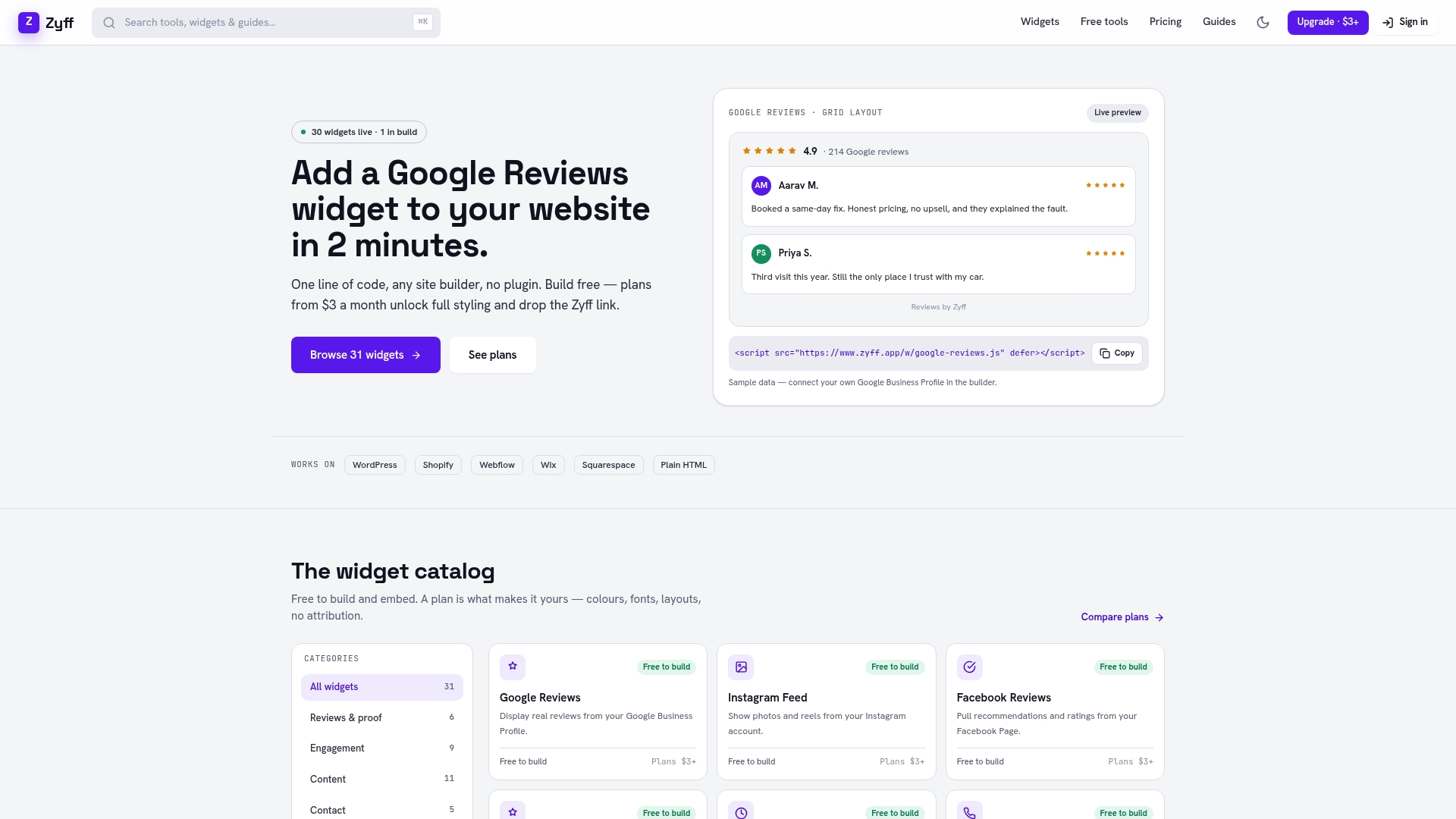
If the pilot works and you want more saved widgets, deeper customization, or team management, our pricing page lists plans from $3 a month. Read our guide on launching a live chat widget in five minutes or see how to add WhatsApp support to your site, then start building your widget today.
FAQ
What is the difference between webchat and a chatbot?
Webchat (or live chat) connects a website visitor to a human agent in real time, while a chatbot is automated software that replies without a person on the other end. Many websites run both: a chatbot handles the first response, and webchat takes over when a human is needed.
What is the difference between a chat box and a chatbot?
A chat box is simply the interface window where a conversation happens, regardless of who or what is replying. A chatbot is the automated system that generates responses inside that chat box; the chat box itself could just as easily connect to a live human agent instead.
What is the difference between a chatbot and a live chat agent?
A chatbot is automated software following scripts or AI models to generate replies, while a live chat agent is a person typing real-time responses. 48% of customers still want the option to reach a human agent for issues that feel too complex or sensitive for a bot.
Should regulated businesses handle chatbot data differently?
Businesses in regulated industries often need stricter data handling for chat transcripts, including encryption and controlled hosting environments. For enterprises considering private or sovereign AI deployments, this guidance on private AI chatbots covers the key questions to ask before committing to an architecture.
How much does Zyff’s chat widget cost to set up?
Building and embedding a chat widget through our widget builder is free to start, with no account required. Paid plans begin at $3 a month on our pricing page for teams that want higher saved widget limits and extended customization.
Sources
- Consumer channel preferences and priorities (Qualtrics / XMI report)
- The state of customer experience 2025 (Verint)
- AI in CX benchmark report 2025 (Forethought)
- How consumers use live chat for customer service (HubSpot)